
Our services
Rail freight
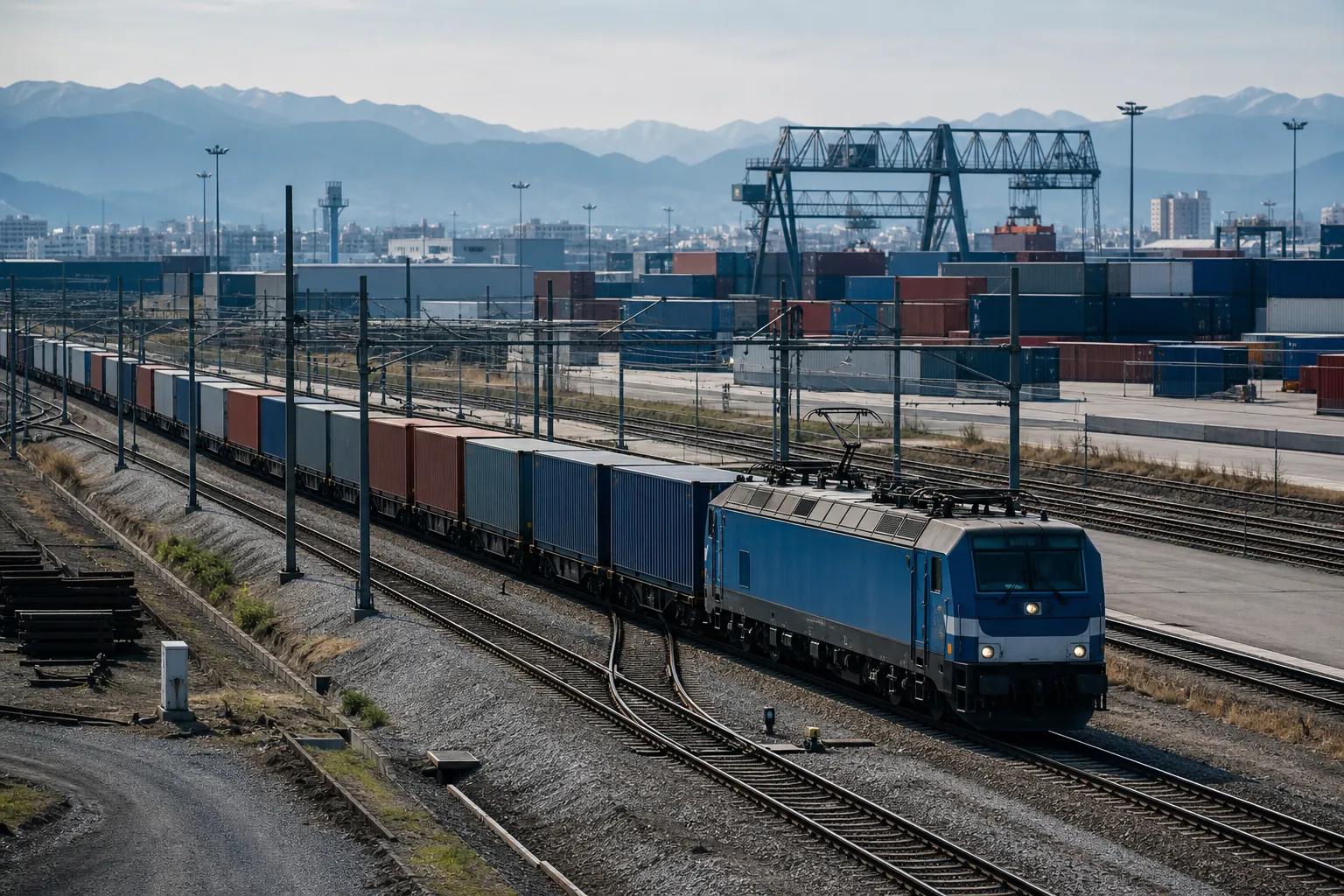
Faster than sea, cheaper than air. Block trains run to a fixed schedule, which makes this the most predictable corridor to plan around. The corridor runs both ways — cargo into Azerbaijan and cargo out of it.
All services
The rail corridors have halved their transit time in recent years. Trains leave to a timetable and depend on weather far less than sea routes do — a decisive advantage for seasonal goods and for cargo tied to a production schedule. Faster than sea, cheaper than air: that is the reason the mode exists on this corridor, not a slogan.
The route into Azerbaijan crosses the borders at Khorgos and Dostyk. The container is transhipped at the border; that stage is part of the 18–25 day transit we quote and carries no extra charge. Block trains run to a weekly timetable. Queues at the border can add two to four days, which is why the quote always names a range rather than a single date.
LCL on rail starts at two cubic metres. Below that, sea groupage or a small road shipment is usually the better fit. From a few cubic metres up to a full 40 ft container the same corridor works; a dedicated container is the option when you do not want to share the box. Loading is from the same Chinese origin cities we use for sea; arrival and clearance are in Baku, handled by our brokers.
The working sequence follows the train, not the other way around. We collect from the supplier, consolidate at the origin warehouse, and load to meet the next departure. Transit documents are prepared before the container moves, because a missing paper at the border is what turns an 18-day run into a 30-day one. You receive a shipment number when the container is on the train, and you can follow each stage through to Baku.
Rail is usually 1.5–2 times the sea rate and roughly half the sea transit. If the cargo is expensive to hold — seasonal stock that misses a window, machinery that a site is waiting for, goods with a short selling season — the difference tends to pay for itself. If the cargo can wait a month and the volume is large, sea is still the cheaper tonne. We put both numbers in the quote when the shipment could go either way.
Not every cargo belongs on a train. Liquids, dangerous goods and temperature-controlled cargo are restricted on this corridor; some of them are banned. Send the packing list before we book space. Furniture, equipment, building materials, textiles and boxed consumer goods are the usual fit, the same families that travel by sea, just with a tighter calendar.
Documents are the commercial invoice, the packing list and the transit paperwork we prepare. HS classification, duty and VAT are calculated in advance, as they are on every other mode, so the landed cost in Baku is known before the train leaves. Door delivery in the destination city is optional; collection after clearance is the default if you have your own transport.
Insurance is optional and worth taking when the cargo is high value or will be transhipped at the border. All-risks cover is 0.3–0.8% of invoice value. The quote is ready in one working day once we have the volume, the weight and the delivery address in Azerbaijan.
The 18–25 day range is origin handling, the train, the border transhipment, and clearance in Baku. The train itself is the predictable part; the border is the variable. We book to a named departure, not to a wish. If the next block train is five days out, that wait is inside the range we quote, not an excuse added later. A missing transit paper at Khorgos or Dostyk is what turns the range into a problem — which is why those papers are prepared before the container moves.
A usable rail quote needs volume, weight, a cargo description, the origin city and the delivery city in Azerbaijan. If the cargo might be restricted — liquids, batteries, anything temperature-controlled — say so in the first message, not after we have reserved space. A dedicated 40 ft container is priced as FCL on this corridor; groupage is priced by the cubic metre from two metres up.
Rail is often compared with sea on price and with air on speed, and both comparisons are fair. What it is not is a substitute for a truck when the cargo has to travel without being opened: the box is transhipped at the border. If that is unacceptable, road is the mode. If a month at sea is acceptable and the volume is large, sea is still cheaper. We put the three figures on one page when the shipment could go any of them.
What the service includes
- Collection from the supplier
- Consolidation and container loading
- Rail freight and border crossing
- Preparation of transit documents
- Customs clearance in Baku
Available on request
- All-risks insurance
- A dedicated 40 ft container
- Door delivery in the destination city
At a glance
- Transit time
- 18–25 days
- Minimum volume
- 2 m³ (LCL)
- Border crossings
- Khorgos, Dostyk
Questions about this service
How much more expensive is rail than sea?
Usually 1.5–2 times, but transit time is roughly halved. If your cargo is expensive to hold, the difference tends to pay for itself.
How reliable is the train schedule?
Block trains run to a weekly timetable. Queues at the border can add 2–4 days, which is why we always quote transit as a range.
Can any cargo go by rail?
Liquids, dangerous goods and temperature-controlled cargo are restricted. Send us the packing list and we will check the route in advance.

Get a quote for this service
Tell us the route, the volume and the type of cargo — we will price it and come back within one business day.